Page 19 of 34

Jeff Morgan examines Cisco’s decision to kill the Flip

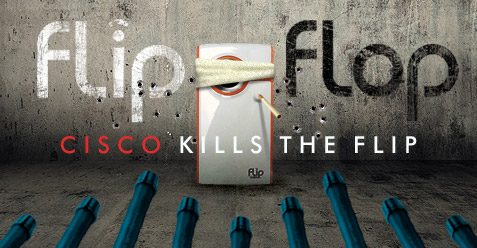
Cisco took the embarrassing step of killing the Flip camera last week. Jeff Morgan digs into the entire episode and he isn’t very impressed with how the tech behemoth handled the entire affair.

To say that Cisco misunderstands the consumer tech market would be like saying NBA players misunderstand what constitutes consent. The company decided just over a week ago to kill off the Flip video, a line of consumer camcorders that Cisco purchased for some $590 million. The key word there is kill, as in kaput – no more Flip. Cisco isn’t even going to try to sell the camcorder line to another company, and probably for good reason – there isn’t a company on the planet that would buy it. Instead, Cisco is simply throwing it away, along with 550 jobs as part of an attempt to refocus the company.

generique cialis 20mg generique cialis 20mg

Cisco should have known better, too. For a company that has dealt with some level of consumer tech for more than 15 years (Linksys was founded in 1995), the Flip move was remarkably dumb. I would have loved to sit in on the meeting in which Cisco offered nearly $600 million for a product that had a very obvious expiration date in the very near future. How do you look at a company that keeps buying up smaller and smaller sensors and not think, ‘Gee, do you think some one will put this in a phone one day, fellas?’ As a matter of fact, let me lay this out for the neanderthals Cisco has running its investments – if you want to buy a piece of tech today, ask yourself whether or not it’s feasible to put that feature into a phone in the near future.

Groupon 2.0

shutterstock_2332593

Groupon is evolving from a crowdsourcing engine to drive customers to restaurants and retailers to a more targeted, time-sensitive tool.

Groupon Now offers two simple buttons – “I’m Hungry” and “I’m Bored.” The idea is simple – to match people in real time and place to establishments looking to get rid of excess goods. Here’s an example:

It’s only 11 a.m. Mason clicks the “hungry” button, and his phone transmits its location to Groupon’s servers and then displays a list of deals from nearby restaurants. Across a bridge spanning the Chicago River, the Asian fusion restaurant Thalia Spice is testing Groupon Now by offering $20 worth of food for $12. A block to the north, an eatery named @ Spot Café is dangling a $10 coupon for $6. Each restaurant has specified that its discount is good only during select hours on that particular day, when a few of their tables would otherwise be empty.

And that, Mason declares as he taps his phone and purchases $8 of savings from Thalia Spice, could turn Groupon into a combination Yellow Pages, Valpak coupon packet, and price-conscious concierge for millions of consumers. “People could end up being driven to eat by what they find on Groupon and when they find it,” he beams.

The advantage for restaurants is pretty obvious, but very significant.

Unlike Groupon’s daily deals, which tend to generate a flood of customers, Groupon Now might lure just a few, but at the right time. Rob Solomon, Groupon’s president, says the true promise of Groupon Now is to help eliminate perishable inventory—food ingredients, labor hours, and anything else that’s wasted if not used immediately. “If we can eliminate 10 percent of perishability, we can change the dynamics for small business owners,” he says. Small businesses would become more like airlines, matching supply against demand to maximize revenues. “If we get this right,” Solomon says, “we are going to influence what tens of millions of people are buying at a frequency that we have never seen before.”

Imagine sushi restaurants in particular. Sushi fans are familiar with half-price sushi nights, and naturally the restaurant cycles its inventory to get rid of the perishable food on those nights. But now they can do flash deals during the week – like all-you-can eat salmon sushi if they have excess inventory they’ll have to toss the next day.

These ideas aren’t really that new, but Groupon’s reach and restaurant contacts put the company in a position to take the most advantage of these types of apps.

The death of Digg

Mike Elgan calls it, along with a detailed critique that explains why this site has fallen on hard times.

This is one of the many problems cited by Elgan, and this one drove us crazy as well.

Digg was anti-blog
Digg always had an inexplicable bias against blog content. In an age when CNN and the New York Times take blogs very seriously, a site like Digg should simply allow blog posts and let the users decide if they’re “weighty” enough.

This is how Digg alienated the bloggers.

Digg is now a mess. It’s still used to try to promote content, but it’s been gamed to the point that normal people can’t submit a story with any hope of having it take off.

Tina Brown snags Andrew Sullivan

I was pretty skeptical when I heard that Tina Brown would be tapped to resurrect Newsweek as a result of the merger with The Daily Beast. So I was pleasantly surprised to see her convince Andrew Sullivan to move his blog from The Atlantic and to join the Newsweek/Daily Beast family. Sullivan is one of the best bloggers on the web, with significant, organic traffic. He’s an excellent commentator, so he’ll be a great addition to Newsweek as well.

Ms. Brown is off to a good start.

« Older posts Newer posts »

© 2026 Linked and Loaded

Theme by Anders NorenUp ↑