Category: Gadgets (Page 5 of 7)

iPad a hit with the elderly

SAN FRANCISCO - JANUARY 27: An event guest plays with the new keyboard on a Apple iPad during an Apple Special Event at Yerba Buena Center for the Arts January 27, 2010 in San Francisco, California. CEO Steve Jobs and Apple Inc. introduced its latest creation, the iPad, a mobile tablet browsing device that is a cross between the iPhone and a MacBook laptop. (Photo by Justin Sullivan/Getty Images)

BusinessWeek is reporting that the iPad is becoming a hit with the elderly, even though there aren’t hard numbers to back up the claim.

The company has sold 3.27 million iPads since its launch in April, but doesn’t break down sales figures by customer age, making it impossible to know with certainty how many seniors are buying them. Anecdotal evidence suggests it’s a hit with the elderly. Marti Weston of Arlington, Va., bought her father one for his 87th birthday in May. “This ‘book-sized’ pad has become my news and entertainment source,” her father, the Reverend Elmo Pascale, raved in a comment on Weston’s blog.

The iPad’s intuitive interface makes it appealing to senior citizens around the world, says Takahiro Miura, a researcher at the University of Tokyo: “The iPad is a good tool for the elderly because it’s very forgiving of mistakes.” Miura’s team uses computers to help train senior citizens to rejoin the workforce. “Unlike the PC, it doesn’t require prior knowledge,” he says.

This makes sense, as ease of use is a critical factor for older computer users. The device is less intimidating, and we can see the logic of seniors becoming enthralled with the device, just like younger users.

New Kindles already sold out!

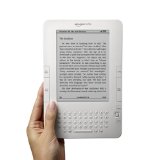
Amazon has released the new Kindle and has reduced the price, and the new versions are already sold out, though you can place an order and get on the waiting list.

This is quite a development when one considers that many were pronouncing the Kindle to be dead upon the release of the iPad. That said, for every fool who made that prediction, there were many savvy tech analysts who pointed out that the Kindle was still superior for long-form reading. That’s the phrase you’ll consistently be hearing from Jeff Bezos. The iPad is a brilliant device that just may help save the magazine and newspaper businesses, but reading a book is a much different experience. In that context, the graphics aren’t necessary, and the glossy screen needed to produce the graphics and touch-screen features is a hindrance to reading in the sun or reading for a long period of time.

Thus, the Kindle and similar devices devoted to the long-form reading market will always thrive.

It might be cool down the road the have a dual-use device, where you have the glossy screen on one side and the Kindle-type screen on the other, but for now I expect to use both devices, and it doesn’t hurt to have a free Kindle app on your iPad so you can do some reading in those cases where you have your iPad but not your Kindle.

Wi-Fi access expands on domestic flights

Here’s some good news for travelers.

In-flight Wi-Fi is not yet a commodity, but it is no longer a rarity. Most domestic airlines have been upgrading their fleets to offer the service more widely, to the point where nearly one-third of the roughly 2,800 aircraft in the nation’s passenger fleet are equipped with Wi-Fi, according to Aircell, the company that equips most of the Wi-Fi-enabled planes in the United States.

If you travel on planes a lot and plan to use Wi-Fi frequently, you can shave some expense from the process if you have a Wi-Fi-enabled mobile device like an iPhone or Droid, which incur lower charges than the fees charged by airlines if you use a smartphone or laptop without Wi-Fi. If you don’t have your own device, airlines are not yet providing one.

But no matter what device you use, the connection process is fast and usually pain free.

On the other hand, an airplane has been one of the few areas where you were forced to go without a connection for a period of time. Wi-Fi can certainly come in handy to kill time or deal with issues that can’t wait, but we’re learning that putting away your phone and laptop can be important for your long-term sanity. I guess we now at least have a choice.

CEO Steve Jobs introduces the new iPhone 4

Apple CEO Steve Jobs poses with the new iPhone 4 during the Apple Worldwide Developers Conference in San Francisco. The new features are quite impressive as Apple builds upon the momentum from the iPad.

Meanwhile, many app developers are worried as AT&T will no longer be offering unlimited data plans. I can see the concern, as users don’t want to worry about what they are consuming. The beauty of many apps is that they are free, or they are so cheap that the decision to purchase is insignificant. This may upset the balance, no matter how good the iPhone gets.

Guarding the app store

Is Apple going too far with some of its restrictive policies surrounding the approval of apps, or is Apple just having a hard time setting the rules for something that exploded in popularity? I guess we’ll find out in due time as Apple’s policies evolve, but in the meantime Apple is on the receiving end of some tough criticism.

An app store lets companies tap into ideas from third-party innovators while retaining firm control over their brands. And that’s both its charm and its flaw. “The way Apple runs the App Store has harmed its reputation with programmers more than anything else they’ve ever done,” wrote Paul Graham, cofounder of the venture firm Y Combinator, on his blog.

The central problem is Apple’s heavy-handed management: Nothing gets into Apple’s store without the company’s express approval. Its restrictions have pushed several high-profile developers to quit the iPhone, and have bred ill will with the programmers who’ve remained. Apple may feel it has room to misbehave. No other phone can offer developers anywhere near the number of customers to be found in the App Store, so what choice do they have?

That’s a miscalculation, because the App Store’s true rival isn’t a competing app marketplace. Rather, it’s the open, developer-friendly Web. When Apple rejected Google Latitude, the search company’s nearby-friend-mapping program, developers created a nearly identical version that works perfectly on the iPhone’s Web browser. Google looks to be doing something similar with Voice, another app that Apple barred from its store. Last fall, Joe Hewitt, the Facebook developer who created the social network’s iPhone app, quit developing for Apple in protest of the company’s policies. Where did he go? Back to writing mobile apps for Web browsers.

Apple’s app bonanza won’t end anytime soon, but you’d be a fool to ignore the long-term trend in software — away from incompatible platforms and restrictive programming regimes, and toward write-once, run-anywhere code that works on a variety of devices, without interference from middlemen. As different kinds of mobile devices hit the market, from phones to tablet PCs to smartpens to e-book readers and beyond, developers will find that trend harder to ignore. They’ll need to create programs that can work not just on iPhones but on everything. Fortunately, there’s an app for that: It’s called the Web.

Apple is riding an incredible wave of success with iPhone apps, and things will only get more hectic with the introduction of the iPad that goes on sale tomorrow. Apple needs to redouble its efforts to control this situation in a manner that is fair to all participants.

« Older posts Newer posts »

© 2026 Linked and Loaded

Theme by Anders NorenUp ↑